
EV Pulse | Malaysia’s EV Story Is Moving Onto the Factory Floor
Malaysia's EV story is moving beyond imports and incentives. Local assembly creates a bigger opportunity to combine automotive experience with EV skills, digital systems, AI and faster-learning dealer networks.
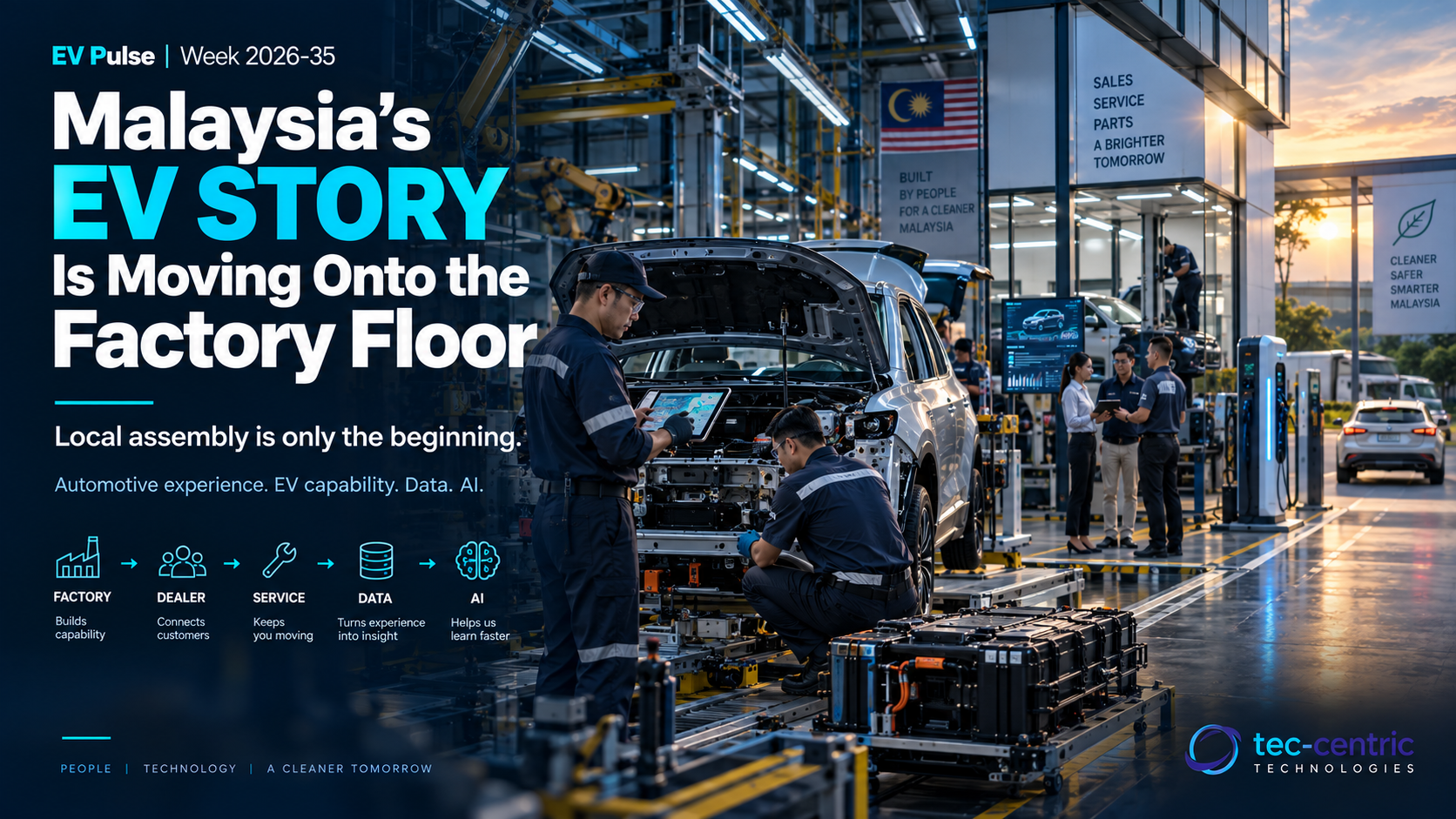
The EV is moving onto the Malaysian factory floor.
The locally assembled XPeng G6 has begun reaching customers from EPMB’s Melaka plant. The updated Volvo EX90 is now assembled in Shah Alam. The Jaecoo J5 EV is also locally assembled in Shah Alam. BYD has confirmed that its Malaysian CKD plans continue through an established local assembly partner, with discussions described as being at an advanced stage.
Malaysia’s EV story is becoming more interesting. The conversation started with imported vehicles, incentives and charging. It then moved into registrations, ownership experience and operating readiness.
Now another layer is becoming visible. Why local EV assembly is only the beginning, and why Malaysia’s next advantage will come from combining automotive experience, EV skills, stronger dealer networks and AI-enabled learning.
These may be separate corporate decisions, but together they point toward something bigger.
“Malaysia is maturing from importing EV momentum to participating more deeply in the overall capability”
And once that starts happening, the opportunity expands far beyond assembly.
The next layer of localization is knowledge
Last week, EV Pulse looked at Malaysia crossing 11% EV share in monthly vehicle registrations and why the next phase would increasingly be about execution.
Before that, in EV Pulse Week 2026-33, we widened the lens from the vehicle itself to the system around it: charging, energy, data, people and operations.
The factory-floor story connects those two ideas. When vehicles become local, capability has an opportunity to become local too. That includes manufacturing knowledge, workshop capability, diagnostics, battery expertise, software understanding, customer education, technician development and the ability to turn field experience into better decisions.
For Malaysia’s established automotive groups, this is a powerful position to be in. They already have something incredibly valuable: experience.
Do we need new infrastructure for EVs?
A strong automotive organization already understands how to run a complex customer and service ecosystem. ICE experience still has enormous value.
It understands workshop discipline, service capacity, parts logistics, warranty management, technical escalation, customer handling, dealer standards, technician productivity, quality systems and the reality of supporting thousands of vehicles after delivery.
Those capabilities transfer. And customers still value them. However, we still need to improve the capabilities to address the safety concerns and the new AI innovations coming into the software.
Deloitte’s 2026 Southeast Asia automotive study found that authorized dealers remain the most common service destination, with service quality, trust and transparent explanations continuing to shape the customer experience. Dealer visits also remain an important source of information during the vehicle-purchase journey.
That tells us something important. The EV transition does not erase automotive experience. It gives that experience a new technology layer.
This was already part of our thinking in EV Pulse Week 2026-20: The Trusted EV Technician of 2026, where we explored how high-voltage systems, software and data are expanding the technician’s role. The next step is to apply the same thinking across the whole automotive organization.
Keep the automotive strength. Add the EV capability.
The dealership of the EV era still needs excellent salespeople, technicians, service advisors, workshop managers and parts teams. Their toolkits simply become richer :
- High-voltage safety joins mechanical safety.
- Battery health joins conventional diagnostics.
- Charging behavior joins fuel-consumption discussions.
- Software updates join parts replacement.
- Vehicle data joins workshop observations.
- Energy cost joins fuel cost in fleet TCO conversations.
And customer education becomes increasingly valuable because the vehicle itself is becoming more connected, more software-driven and more capable of changing throughout its life.
Malaysia is already building this layer. PRO-NET recently certified its first 37 Level 2 e.MAS EV technicians across 25 authorized dealerships, following seven training modules that included high-voltage competencies. Proton’s wider e.MAS ecosystem had reached 58 dealerships, 45 service centres and 10 Body & Paint centres by mid-2026.
That is what capability development looks like in practice. Vehicles scale. Networks scale. Skills scale with them.
The dealer network can become something much more valuable
There is another evolution happening quietly. Traditionally, the dealer network can be described as: Sales → Service → Parts
In the EV, connected-vehicle and AI era, it can become:
Factory ↗ Dealer ↗ Data ↗ Learning ↗ Customer ↗ Factory
Think about what a good dealer network sees every day. It sees :
- which customer questions repeat.
- where charging explanations need improvement.
- which faults occur frequently.
- how different customers actually use vehicles.
- technician knowledge gaps.
- parts demand.
- warranty patterns.
- which service processes create confidence and which processes can be improved.
That is extremely valuable operating knowledge. As the systems connecting vehicles, workshops and customers improve, more of that knowledge can be structured and used. The dealer network can evolve from a distribution network into a distributed learning network.
This is particularly relevant now. On 21 September, XPeng Malaysia announced plans for 10 additional 3S and 4S locations by the end of 2026, combining retail, aftersales, charging infrastructure and dealer partnerships as part of what the company describes as its smart EV ownership ecosystem. Physical networks still matter. What changes is how intelligently those networks learn.
And this is where AI becomes practical
AI becomes much more useful when we stop treating it as a separate technology conversation. In automotive, its value can sit directly inside workflows that people already understand.
- A technician can retrieve the right service information faster.
- A service advisor can translate technical findings into clearer customer language.
- A workshop manager can identify recurring diagnostic patterns.
- A parts team can improve demand planning.
- A training manager can see where capability gaps are forming.
- A dealer principal can bring together service, customer, warranty and operating signals that previously lived in separate places.
- AI can help turn experience into accessible knowledge.
McKinsey’s recent work on automotive aftermarket and services highlights AI applications across customer interaction, diagnostics, troubleshooting, planning, dispatch, parts decisions and knowledge search. The business opportunity is therefore broader than automation alone. It includes consistency, speed, better customer experiences and the ability to scale expertise.
BMW is also applying AI upstream in battery-cell development, using models to accelerate learning from production data and reduce the time and resources required to understand which processes work best.
The pattern is worth noticing: AI becomes powerful when domain expertise already exists. For automotive organizations with decades of operational experience, that is an encouraging thought.
The capability stack is becoming clearer
At Tec-Centric Technologies, we see this evolution as a capability stack rather than a replacement cycle:
- Automotive foundation ↗ Dealer operations ↗ Workshop discipline ↗ Customer experience ↗ Parts, warranty and service processes
- EV capability ↗ High-voltage systems ↗ Batteries and charging ↗ Thermal management ↗ EV diagnostics ↗ TCO and ownership knowledge
- Digital capability ↗ Connected vehicles ↗ Software-defined systems ↗ Vehicle and workshop data ↗ Digital service workflows
- AI capability ↗ Knowledge retrieval ↗ Diagnostic support ↗ Pattern recognition ↗ Predictive insight ↗ Customer and technician assistance
- Business outcome ↗ Better uptime ↗ Faster learning ↗ Stronger customer confidence ↗ More consistent service ↗ Higher workforce capability
That sequence matters because when an organization already understands automotive operations, it has an excellent platform from which to build the next layer.
This is a particularly strong opportunity for Malaysia’s established automotive players
A long-standing dealer group does not begin the EV era from zero. It begins with customers, facilities, experienced people, operating processes, supplier relationships, local knowledge and trust.
Now imagine adding structured EV capability to that foundation. Then connected-vehicle data. Then AI-supported knowledge. Then a learning loop that continuously improves technicians, customer communication, workshop decisions and management visibility. That creates a very different type of automotive organization.
And it gives experienced Malaysian groups a real opportunity to combine what they already do well with what the next generation of mobility requires. This is where experience and innovation meet naturally.
Our view: localization should include intelligence
Local assembly matters because it creates industrial participation. The wider opportunity is to let that participation travel further through the ecosystem.
From assembly to capability. From capability to knowledge. From knowledge to better decisions. From better decisions to stronger customer value.
That is a positive pathway for OEMs, dealer groups, suppliers, fleet operators, technical institutions and the broader Malaysian mobility ecosystem.
Earlier, in EV Pulse Week 2026-29: Malaysia’s EV Showroom Race Is Moving Beyond the Sale, we argued that the ownership experience would become part of the competitive advantage.
- The factory-floor evolution strengthens that argument.
- The vehicle can now be built closer to the market.
- The service capability can grow closer to the customer.
- The knowledge can stay closer to the organization.
And AI can help that knowledge travel faster to the people who need it.
Leadership takeaway
Malaysia has decades of automotive capability to build from. That experience can become even more valuable when it is combined with EV systems, software, data and AI-enabled ways of working.
For established dealer groups and automotive stakeholders, the opportunity is therefore bigger than adapting to a new powertrain. It’s an opportunity to evolve into a faster-learning automotive organization.
At Tec-Centric Technologies, this is where our focus sits: connecting automotive and fleet experience with EV capability, digital transformation, AI, data and practical workforce development, then translating those technologies into operating value.
The question is no longer simply how much automotive experience an organization has. A more useful question is: How quickly can that experience be converted into the capability the next mobility era needs?
And Malaysia already has much of the foundation required to do it.
The EV may be assembled locally. The real advantage grows when the intelligence around it becomes local too.
If you are a fleet operator, logistics leader, automotive player, corporate decision-maker, or training team looking at EV transition, fleet readiness, future skills, or practical EV capability-building, this is the right time to start the conversation.
Find out more about our courses: https://www.tec-centric.tech/courses2026
For consulting, training, workshops, and collaboration enquiries: https://www.tec-centric.tech/contact
Visit our website: https://www.tec-centric.tech
Follow Tec-Centric Technologies on LinkedIn: https://www.linkedin.com/company/tec-centric-technologies/
Subscribe to EV Pulse: https://www.linkedin.com/newsletters/ev-pulse-7349681316704964608/
Original published edition
EV Pulse is also published through LinkedIn. Open the original edition for the source post and industry discussion.
Read the complete LinkedIn edition